




If you are wondering what to check on your Chevy before winter arrives, the short answer is five things: tire pressure, battery condition, wipers and cabin air filter, coolant and oil, and brake pads and rotors. Falling temperatures change how each of these systems behaves, and a vehicle that ran fine all summer can develop a tire pressure warning, a slow crank, or foggy glass within the first cold snap of the season. Dobbs Brothers Chevrolet of Bartlett sees this pattern every fall across Bartlett, Memphis, Cordova, and the rest of Shelby County, and it is predictable enough that a single appointment can usually catch it before it turns into a stranded car or a holiday travel delay.
This checklist is for Chevy owners who want a straightforward, non-generic rundown of what actually changes with the season, not just a list that could apply to any car in any city. We wrote it with Silverado, Equinox, Traverse, and Tahoe owners in mind, since those are the vehicles we see most often in our Bartlett service drive, but the same checks apply across the lineup. By the end, you will know what to check yourself, what we recommend leaving to our service team, and what current specials make the timing easier.
The Fall Checklist: What Actually Changes When Temperatures Drop
We start every fall checklist with tires and battery, because those are the two systems most likely to trigger a warning light or a no-start in the first real cold snap.
Here's the five-system rundown at a glance before we walk through each one:
| System | What Changes in Fall | What We Check |
|---|---|---|
| Tires and TPMS | Pressure drops roughly 1 PSI per 10 degree Fahrenheit temperature drop | Cold tire pressure, tread depth, wear patterns, valve stem condition |
| Battery and charging system | Summer heat damage tends to surface as a cold-weather failure | Conductance test, terminal corrosion, case condition |
| Wipers and cabin air filter | UV and heat wear from summer shows up as reduced fall visibility and weaker defrost | Blade condition, filter airflow and clogging |
| Coolant and oil | Temperature swings raise the stakes on fluid protection levels | Coolant level and condition, Oil Life Monitor status |
| Brakes | Holiday travel adds miles and more stop-and-go braking | Pad thickness, rotor condition |
Tires and TPMS
Tire pressure drops by roughly 1 PSI for every 10 degree Fahrenheit drop in outside temperature, and that relationship is why a Tire Pressure Monitoring System light that never came on in August can suddenly appear in October or November. A tire that reads 35 PSI on a 90 degree afternoon can read several pounds lower once overnight lows drop into the 50s, and Bartlett's fall pattern of warm afternoons and cool mornings makes that swing happen faster than a lot of drivers expect.
We recommend checking tire pressure with a gauge when the tires are cold, meaning before the vehicle has been driven that day, rather than relying on the dashboard light alone.
A few things worth checking at the same time:
- Tread depth on all four tires, including the spare if your Chevy has one
- Uneven wear patterns that can point to an alignment issue before winter driving makes it worse
- Valve stem condition, since a slow leak often shows up first as a fall TPMS warning
If your tires are original equipment and several years old, our team can also look at overall tire age and let you know honestly whether they are good for another season or due for replacement through our tire center.
Battery and Charging System
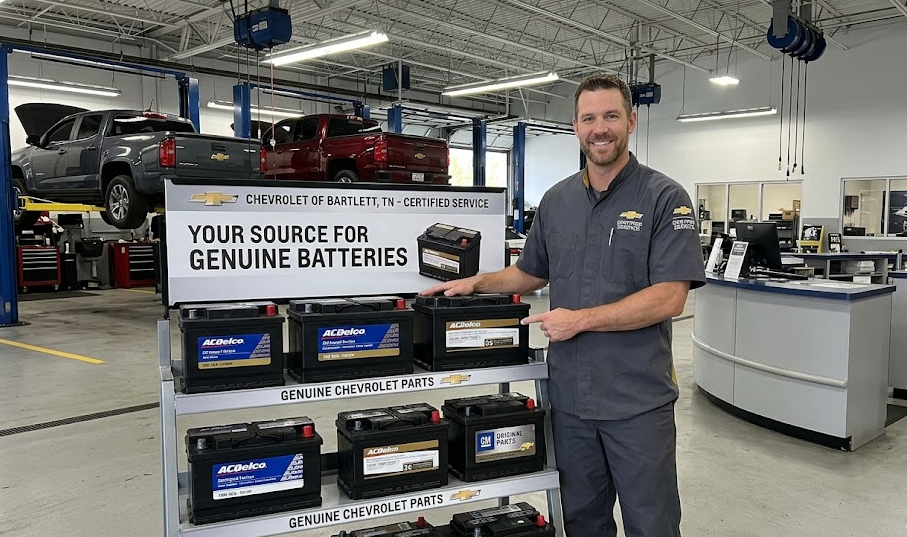
A battery that struggles in December was often already weakened months earlier. We cover the mechanics of this in detail in our battery testing guide, but the short version matters here too: summer heat causes more of the underlying chemical wear on a battery than cold does, and cold weather is simply when a battery that is already weak finally fails to deliver enough current to start the engine. Fall is the window to catch that weakness with a conductance test before it becomes a no-start morning.
We recommend a battery test as part of your fall visit if your battery is three years old or older, or if you noticed slower cranking at any point this year. Ask our service team about current battery rebate offers when you schedule.
Wipers, Visibility, and Cabin Air Filter
Wiper blades wear from UV exposure and heat as much as from ice, so a set that looked fine in July can already be cracked or streaking by the time fall rain and reduced daylight make visibility more important. Many drivers replace wiper blades twice a year, once in spring and once in fall, and that rhythm works well for our climate.
Cabin air filters affect defrost and windshield fogging as much as they affect odor and allergens, since a clogged filter restricts the airflow your HVAC system uses to clear the glass. If you have noticed weaker airflow, more window fog than usual, or it has been a while since it was replaced, our parts counter can check the correct filter for your specific Chevrolet and current mileage.
Fluids, Brakes, and What We Check at a Multi-Point Inspection
We treat fluids and brakes as a pair in the fall, because holiday travel season tends to add both miles and stop-and-go traffic at the same time.
Coolant, Oil, and dexos1 Full Synthetic
Chevrolet vehicles use Dex-Cool coolant, and ACDelco offers it both as a 50/50 pre-mix and as a concentrate under the Dex-Cool Extended Life name. Coolant does not need to be topped off every fall, but it is worth a level and condition check before temperatures swing, since a low coolant level or a coolant that has gone past its service life offers less protection against both overheating and freezing. Your specific coolant change interval is set by your Owner's Manual, so we always confirm that against your exact model and mileage rather than applying a blanket number. The Oil Life Monitor applies to engine oil, not coolant.
The same is true for oil. We use ACDelco GM Original Equipment dexos1 full synthetic oil for Chevrolet gas engines that specify it, and our current service menu includes a 6-quart and an 8-quart full synthetic oil change and tire rotation package depending on your engine size. If your Oil Life Monitor indicates service is due or your mileage is approaching the interval your Owner's Manual specifies, fall is a practical time to combine that with the rest of this checklist in one visit.
A few fluid checks worth adding to the list:
- Windshield washer fluid, since visibility needs increase with fall rain and road grime
- Brake fluid level and condition
- Power steering fluid, if your Chevrolet uses a separate reservoir rather than an electric system
| Fluid | What Changes in Fall | What We Recommend |
|---|---|---|
| Coolant (Dex-Cool) | Temperature swings increase demand on protection levels | Level and condition check; exact interval set by your Owner's Manual |
| Oil (dexos1 full synthetic) | Holiday-travel mileage can push you closer to your interval | Follow your Oil Life Monitor or maintenance minder |
| Windshield washer fluid | Fall rain and road grime increase visibility needs | Top off and check for streaking |
| Brake fluid | Supports braking performance through holiday stop-and-go traffic | Level and condition check |
| Power steering fluid | Not fall-specific, but a practical add to the same visit | Level check if your Chevrolet uses a separate reservoir |
Brake Pad and Rotor Inspection Before Holiday Travel
Brake wear is gradual, which is exactly why it is easy to miss until a grinding noise or a soft pedal shows up during a longer holiday drive. We inspect pad thickness and rotor condition as part of a multi-point inspection, and we can tell you honestly whether you have a season of wear left or whether it makes sense to handle it before travel season adds more miles and more stop-and-go braking in Memphis-area traffic. Ask our service advisors about current brake pad and rotor rebate offers, since those tend to make this an easier item to handle proactively rather than reactively.
If you want to get ahead of your fall checklist before the holiday travel rush, our service team at 901-382-5644 can get you on the schedule, walk through what your specific Chevrolet needs based on its mileage and maintenance history, and let you know about any current specials on the items above. You can also book online through our schedule service page, and if you would rather see everything currently running at once, our service and parts specials page lists what is active right now. We would rather catch a worn pad or a weak battery in October than have you dealing with it on the side of US-64 in January.
Bartlett and Memphis-Area Fall Driving Context
Our fall driving conditions in Bartlett and the Memphis metro are less about deep cold and more about sharp daily swings, which is exactly what stresses tires and batteries the fastest.
Temperature Swings, Wet Roads, and Holiday Travel Timing
Bartlett and the surrounding Memphis metro typically see fall afternoons still reaching into the 70s or 80s well into October, with overnight lows dropping into the 50s or lower by November. That gap between daytime high and overnight low is what drives the tire pressure swings we described earlier, and it happens earlier in the season here than it does in colder-climate markets where the whole day simply stays cold. Add in fall rain and wet leaves on routes like I-40, I-240, and US-64, and reduced tire tread or a wiper blade that streaks becomes a visibility and traction issue faster than it would in dry summer conditions.
Holiday travel adds another layer specific to this time of year. Whether you are driving to see family in Nashville, Little Rock, or across the state line into DeSoto County or eastern Arkansas, or just handling more school runs and errands as daylight hours shorten, a fall checkup catches problems before a longer trip does. If your Chevrolet is also used for contractor work or towing to Pickwick or Reelfoot before the season ends, tire pressure and brake condition matter even more with a loaded trailer.
If you want to handle your fall parts needs at the same time, our parts counter can get you wiper blades, a cabin air filter, or an ACDelco battery ready for pickup or installation. Call us at 901-382-5644, order online through our parts ordering page, or stop by our Bartlett location at 7850 US-64. We can also check fitment against your exact VIN so you are not guessing at the right part for your trim and model year.
Regional Driving Context: Why Our Temperature Swings Are Harder on a Chevy Than a Steady Cold Snap
A 30 degree swing between a Bartlett afternoon and the following morning puts more stress on tire pressure and battery load in a single day than a week of steady cold does in a northern climate.
A lot of fall maintenance advice is written for markets where the temperature drops and stays down. That is not really how it works here. Memphis-area fall days regularly swing 25 to 35 degrees between afternoon high and overnight low well into November, and each swing is effectively a full pressure and cold-crank cycle for your tires and battery. A vehicle in a market with a steady 45 degree day sees one cold-weather event; a vehicle here can see that swing daily for weeks.
This is also why a Chevy that seems fine on a warm afternoon test drive can trigger a TPMS light or crank slower the next cold morning. It is not that the vehicle got worse overnight. It is that the swing exposed a tire that was already a little low or a battery that was already a little weak. Checking these systems once in early fall, rather than waiting for the first hard freeze, matches how our local climate actually behaves rather than how a generic national checklist assumes it does.
Local Dealer Insight: What Our Multi-Point Inspection Actually Covers
A multi-point inspection catches most of this checklist in one visit, which is why we recommend it over handling each item separately as it comes up.
A quick oil change covers exactly that, the oil and usually the filter. Our multi-point inspection is broader, and it is worth understanding the difference before deciding which one fits your fall visit.
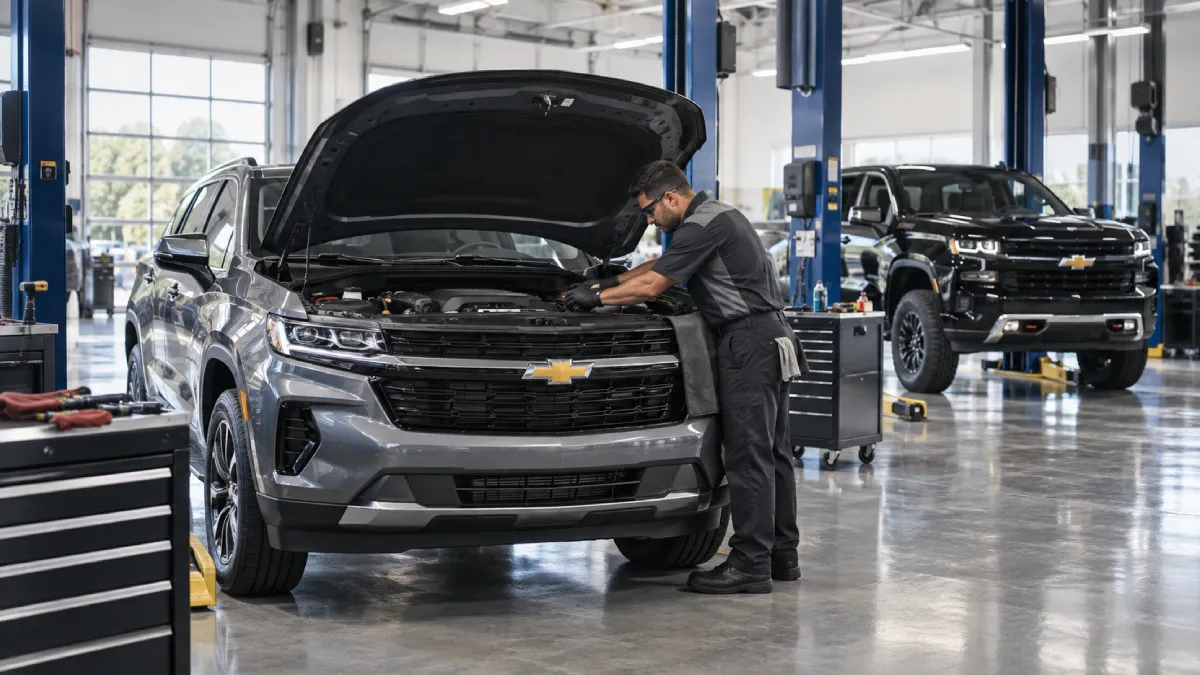
During a multi-point inspection, our technicians typically check:
- Tire tread depth and pressure on all four tires plus the spare
- Battery condition and charging system output
- Brake pad thickness and rotor condition on all four corners
- Fluid levels, including coolant, brake fluid, and washer fluid
- Wiper blade condition and belt and hose condition where visible
- Cabin and engine air filter condition
| What We Check | Why It's Part of a Fall Multi-Point Inspection |
|---|---|
| Tire tread depth and pressure, all four plus spare | Catches pressure swings and wear before winter driving |
| Battery condition and charging system output | Catches summer heat damage before it becomes a cold-weather no-start |
| Brake pad thickness and rotor condition | Holiday travel adds miles and stop-and-go braking |
| Fluid levels (coolant, brake fluid, washer fluid) | Protects against both overheating and freezing as temperatures swing |
| Wiper blade, belt, and hose condition | Affects visibility and reliability through fall rain |
| Cabin and engine air filter condition | Affects defrost performance and airflow |
The value of doing this once in the fall rather than piecemeal is that you get one honest report on where your Chevy stands heading into winter, instead of finding out about a weak battery in November, worn brakes in December, and low tread in January, each one on its own inconvenient timeline. Ask our service advisors about current complimentary multi-point inspection offers when you schedule; availability and specific terms can change, so our team can confirm what is currently running.
Key Takeaways
- Tire pressure drops roughly 1 PSI for every 10 degree Fahrenheit temperature drop, which is why a TPMS light often appears for the first time in fall.
- A weak battery is usually the result of summer heat damage that shows up as a cold-weather failure, so a fall battery test can catch it before winter.
- Use the coolant and engine oil specified in your Chevrolet's Owner's Manual, including Dex-Cool and ACDelco dexos1 full synthetic where specified. Follow the manual for coolant intervals and the Oil Life Monitor and manual for oil service rather than a blanket schedule.
- Wiper blades and cabin air filters directly affect visibility and defrost performance, not just comfort, making them a practical fall priority.
- Our multi-point inspection covers tires, battery, brakes, fluids, and filters in one visit, which is more efficient than handling each item as it comes up separately.
- Bartlett's sharp day-to-night fall temperature swings stress tires and batteries faster than a steady cold climate does, which is why we recommend an early fall check rather than waiting for the first freeze.
FAQ: Fall Chevy Maintenance in Bartlett
How often should I rotate my tires in the fall?
We follow the tire rotation interval in your Chevrolet's Owner's Manual, which is typically every 7,500 miles, subject to your model's specific requirements, but fall is a convenient checkpoint to confirm you are on schedule. Our current oil change packages include a tire rotation, which makes it easy to combine both in one visit. If you are noticing uneven wear or pulling to one side, we recommend having our team check your alignment at the same time rather than waiting for the next scheduled rotation.
Do I need a coolant flush every fall?
Not necessarily every year. Your Chevrolet's coolant change interval is set by your Owner's Manual and by the type of Dex-Cool coolant your vehicle uses, and many Chevrolet coolant systems are designed for extended service life rather than an annual flush. What we do recommend every fall is a level and condition check, since a low coolant level or coolant that has degraded past its service life offers less protection right when temperature swings increase. Our team can tell you where your specific vehicle stands.
What is the difference between a quick oil change and a multi-point inspection?
A standalone oil change covers the oil and filter and typically a tire rotation. Our multi-point inspection is broader and includes tires, battery and charging system, brake pads and rotors, fluid levels, wipers, and cabin and engine air filters, giving you one comprehensive look at how your Chevy is holding up before winter rather than a single-system check. We recommend the multi-point inspection specifically for a fall visit since it catches the range of items that change with the season.
Should I switch to winter wiper blades in Memphis?
Dedicated winter wiper blades are built for heavy snow and ice accumulation, which is less of a daily concern in the Memphis metro than in colder northern markets. What matters more here is blade age and condition, since UV exposure and heat during our long summers can crack or wear standard blades before winter even arrives. We recommend replacing wiper blades on a spring and fall schedule regardless of blade type, and our parts counter can help you choose the right blade for your specific Chevrolet.
Our team at Dobbs Brothers Chevrolet of Bartlett would rather help you catch a low tire, a weak battery, or worn brake pads in October than have you dealing with any of it on a cold morning in January. We are Chevrolet authorized for both sales and Chevrolet Certified Service, our technicians work from GM Genuine Parts and ACDelco components, and our service department at 7850 US-64 in Bartlett serves drivers throughout Memphis, Cordova, Germantown, Collierville, and the rest of Shelby County and the West Tennessee area.
If you are ready to get your Chevy checked before the season turns, call our service department at 901-382-5644 or schedule online, and ask us about current specials on batteries, wipers, cabin air filters, and brake components while you are at it. We look forward to getting your Chevy ready for whatever this fall brings.