




A car battery can lose about 60 percent of its strength at 0°F, at the exact moment cold-thickened engine oil demands more cranking power to start the engine. That combination is why a battery that seemed fine in October can leave you stranded on a cold morning in January. Dobbs Brothers Chevrolet of Bartlett sees this pattern every year as the weather turns, and it's rarely the cold itself that actually damages the battery. If you're a Chevy owner in Bartlett, Memphis, or anywhere across Shelby County wondering whether your battery will make it through winter, this article walks through what actually happens to a battery in cold weather, what our service team checks during a battery test, and why the West Tennessee summer you just drove through may matter more to your battery's health than the winter ahead.
Why Cold Weather Causes Battery Failure
We'd put it this way: cold weather doesn't usually create a battery problem, it exposes one that was already there.
The Chemistry, Reduced Power Output Plus Higher Cranking Demand
A lead-acid battery generates power through a chemical reaction, and that reaction slows down as temperatures drop, the same way most chemical reactions do. The practical result is a battery that can lose about 60 percent of its available strength at 0°F. At the same time, cold weather thickens engine oil, which means the starter needs more electrical current to turn the engine over than it would on a warm day. A battery that was already running at reduced capacity, combined with an engine that suddenly needs more power to start, is exactly the scenario that produces a no-start on a cold morning.
Warning Signs Your Battery Is Already Weak
Chevrolet's own guidance points to a few specific signs that a battery needs attention regardless of the season:
- A cracked, leaking, swollen, or bloated battery case, which indicates the battery should be replaced rather than tested further
- Slower-than-normal engine cranking, even in mild weather
- Corrosion building up around the battery terminals
- A battery that is already 3 to 5 years old, since that's the typical service life Chevrolet cites, depending on driving habits and climate
If any of these apply to your Chevy, we'd rather have our service team look at it now than have you find out on a 28-degree morning in December. Here's how we'd read each of those warning signs:
| Warning Sign | What It Usually Indicates | What We Recommend |
|---|---|---|
| Cracked, leaking, swollen, or bloated case | Internal damage that testing alone won't fix | Replacement, not further testing |
| Slower-than-normal cranking in mild weather | Reduced capacity even without cold stress | Conductance test as soon as possible |
| Corrosion around the terminals | Connection interference that can mimic a weak battery | Terminal cleaning and inspection, then retest |
| Battery is 3 to 5 years old or older | Approaching or past typical service life | Proactive conductance test before winter |
If you're seeing more than one of these at once, that combination is usually a stronger signal than any single sign on its own.
What Our Service Team Checks and What Gets Replaced
We test for the ability to deliver power under load, not just whether the battery shows a charge.
Conductance Testing, Terminal Inspection, and Case Condition
During a battery check at our service department, our technicians perform a conductance test, which measures how well the battery can deliver current under load rather than simply checking its resting voltage. We also inspect the battery case for cracks, leaks, or swelling, and check the terminals for corrosion that can interfere with a clean electrical connection even when the battery itself is otherwise healthy. This combination catches most of the failure modes that show up as a no-start, rather than relying on age alone to decide whether a battery needs replacing.
AC Delco Replacement and CCA vs. Reserve Capacity
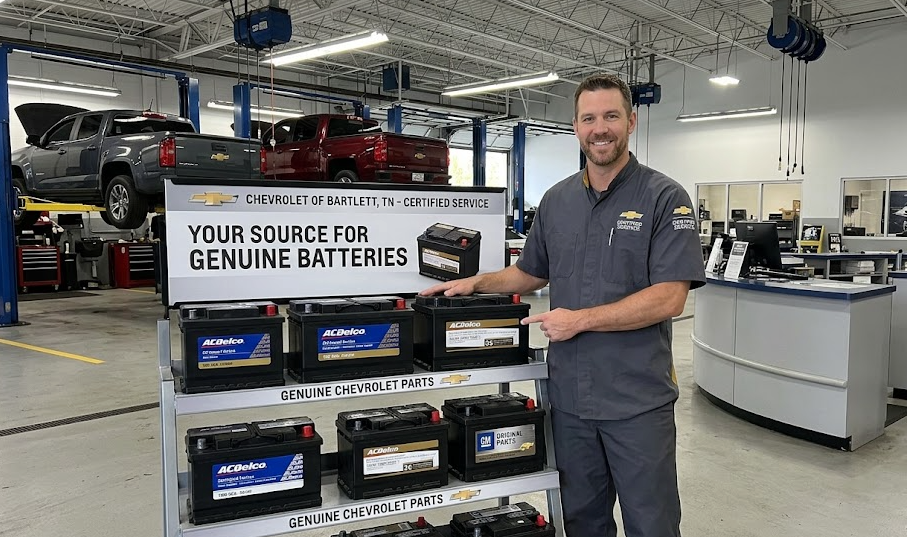
When a battery does need replacing, we stock AC Delco batteries built to Chevrolet's specifications. AC Delco's own guidance emphasizes finding the right balance between cold cranking amps (CCA), which measures starting power in cold conditions, and reserve capacity (RC), which measures how long a battery can run essential systems if the alternator stops charging. Reserve capacity matters more than it used to, since modern vehicles run more onboard electronics that draw power even when the engine isn't providing a charge. Our parts counter can walk you through which AC Delco battery matches your specific Chevy model and its current warranty terms, since those terms can change and we'd rather confirm them for your exact battery than quote something that may no longer apply.
Here's what each part of a battery check actually tells us:
| What We Check | What It Tells Us |
|---|---|
| Conductance test | How well the battery delivers current under load, not just resting voltage |
| Terminal inspection | Whether corrosion is interfering with a clean electrical connection |
| Case condition | Whether cracking, leaking, or swelling means the battery needs replacing outright |
| Cold cranking amps (CCA) rating | Starting power available in cold conditions |
| Reserve capacity (RC) rating | How long the battery can run essential systems if the alternator stops charging |
Schedule a Battery Test With Our Service Team
If you'd rather know now than find out on a cold morning, our service department at Dobbs Brothers Chevrolet can run a full battery test as part of a scheduled visit or alongside other maintenance you already have planned. We can check your battery's conductance, inspect the terminals and case, and tell you honestly whether it's holding up or heading toward replacement. Call our service department at 901-382-5644, or schedule a battery check online at a time that works for you. We would rather spend fifteen minutes confirming your battery is solid than have you deal with a no-start call from a parking lot.
When Bartlett and Memphis-Area Drivers Should Get Tested
We think the best time to test a battery in this area is right after summer, not right before the first freeze.
Local Timing and Driving-Condition Context
West Tennessee summers put real stress on a car battery, and Chevrolet's own guidance points to warmer climates accelerating battery wear through a process called sulfation, which is separate from whatever cold weather does later. Bartlett and Memphis drivers who spend months in high heat and humidity, then face an occasional hard freeze or ice event in December or January, are effectively asking a battery to survive both ends of that stress in the same year. That's part of why we'd rather test batteries in early fall, once the worst of the heat has passed, instead of waiting until a cold snap is already in the forecast.
Ask Our Parts Counter About AC Delco Replacement
If your battery test shows it's time for a new battery, our parts counter can help you get the right AC Delco battery for your specific Chevy model rather than a generic replacement. We carry AC Delco batteries built to Chevrolet's cold cranking amps and reserve capacity specifications, and we can also handle the installation at our service department on US-64 so you're not doing it yourself in a parking lot. Reach our parts counter at 901-382-5644, or stop by 7850 US-64 in Bartlett to see what's currently in stock for your model. Current pricing and warranty terms can vary by battery type, so we'd confirm those with you directly rather than quote a number here.
Contrarian Insight: It's Not Just the Cold, Memphis Summers Set It Up
We'd push back on the common assumption that winter is when battery damage actually happens.
Most battery advice treats cold weather as the villain, but Chevrolet's own guidance says warmer climates cause more underlying battery damage, through a process called sulfation, than cold weather does. Cold weather is usually just the moment a battery that was already weakened by months of West Tennessee heat finally fails to deliver enough power. That distinction matters for when you actually get tested. If you wait until the first cold snap to think about your battery, you're reacting to the symptom rather than the cause, since the real damage from a Memphis summer already happened months earlier. We'd rather Bartlett-area drivers think of battery testing as a fall maintenance item that follows summer, the way you'd check tire pressure after a big temperature swing, rather than a purely winter concern.
Regional Driving Context: When to Actually Get a Battery Test
We'd recommend building a battery check into your fall routine rather than waiting for a warning light or a slow start.
Here's how we'd time it for Bartlett, Cordova, Germantown, and the rest of the Memphis metro:
- Early fall, after the peak of summer heat, is the best window to catch sulfation damage before it turns into a cold-weather failure
- Any time your battery is 3 years or older, since that's within Chevrolet's typical 3 to 5 year service life range and testing costs far less than a tow
- Before a long highway trip, whether that's toward Nashville, down to the Gulf Coast, or across into Arkansas or DeSoto County, Mississippi
- Immediately if you notice slow cranking, dashboard warning lights, or visible corrosion on the terminals, regardless of season
| Situation | Why It Matters |
|---|---|
| Early fall, after peak summer heat | Catches sulfation damage from summer heat before it becomes a cold-weather failure |
| Battery is 3 years old or older | Falls within Chevrolet's typical 3 to 5 year service life range |
| Before a long highway trip | Reduces the chance of being stranded far from home |
| Slow cranking, warning lights, or visible corrosion | These symptoms call for testing regardless of season |
Key Takeaways
- Car batteries can lose about 60 percent of their strength at 0°F, while cold-thickened oil simultaneously increases the power needed to start the engine.
- Chevrolet's own guidance points to warmer climates, not cold weather, as the bigger driver of underlying battery damage through sulfation.
- Our service team performs a conductance test, checks the battery case for cracks or swelling, and inspects terminals for corrosion during a battery check.
- Chevrolet batteries typically last 3 to 5 years depending on driving habits and climate, and AC Delco balances cold cranking amps with reserve capacity rather than maximizing CCA alone.
- For Bartlett and Memphis-area drivers, early fall is a better time to test a battery than right before the first freeze, since it catches summer heat damage before winter exposes it.
- Our parts counter stocks AC Delco batteries built to Chevrolet's specifications and can confirm current pricing and warranty terms for your exact model.
FAQ
Can I charge a frozen car battery?
No. Chevrolet's own guidance specifically warns against attempting to charge a frozen battery, since doing so may cause the battery to explode. If you suspect your battery has frozen, which typically only happens to a battery that was already significantly discharged, we'd recommend having it inspected by our service team rather than attempting to charge or jump-start it yourself.
How long do car batteries typically last?
Chevrolet's guidance cites a typical service life of 3 to 5 years, though the exact number depends heavily on driving habits and climate. In our experience serving Bartlett and Memphis-area drivers, batteries that spend significant time in summer heat may show wear on the earlier end of that range, which is part of why we recommend testing rather than assuming a battery is fine just because it hasn't failed yet.
Is a free battery check actually useful?
Yes, when it includes an actual conductance test rather than just a voltage reading. A conductance test measures how well your battery delivers power under load, which is a much better predictor of whether it will start your car on a cold morning than checking whether it shows a charge while sitting still. Our service team performs this type of test as part of a battery check at our Bartlett location.
Should I replace my battery every few years even if it still works?
Not automatically, but we'd recommend testing rather than waiting for it to fail outright. A battery within Chevrolet's typical 3 to 5 year range can still test as healthy, and replacing a battery that's still performing well isn't necessary. Testing tells you where your specific battery actually stands instead of guessing based on age alone.
We test batteries for Bartlett, Memphis, Cordova, and Shelby County drivers every week, and we'd rather catch a weakening battery in October than have you deal with a no-start in January. As a Chevrolet Certified Service department stocking AC Delco batteries built to Chevrolet's specifications, we can run a full conductance test, inspect your terminals and case, and give you an honest read on where your battery stands. Stop by our service department at 7850 US-64 in Bartlett, or call us at 901-382-5644 to schedule a battery check. We can also confirm current AC Delco pricing and warranty terms if a replacement turns out to be the right call.