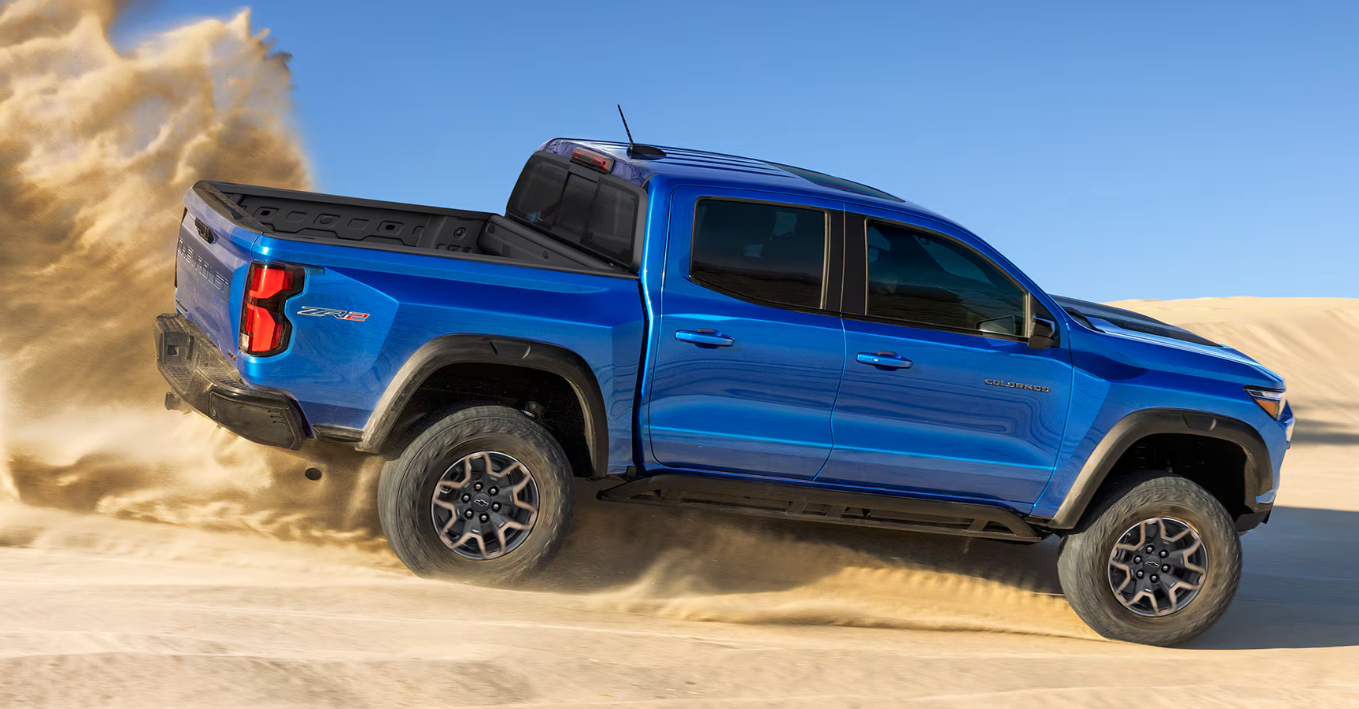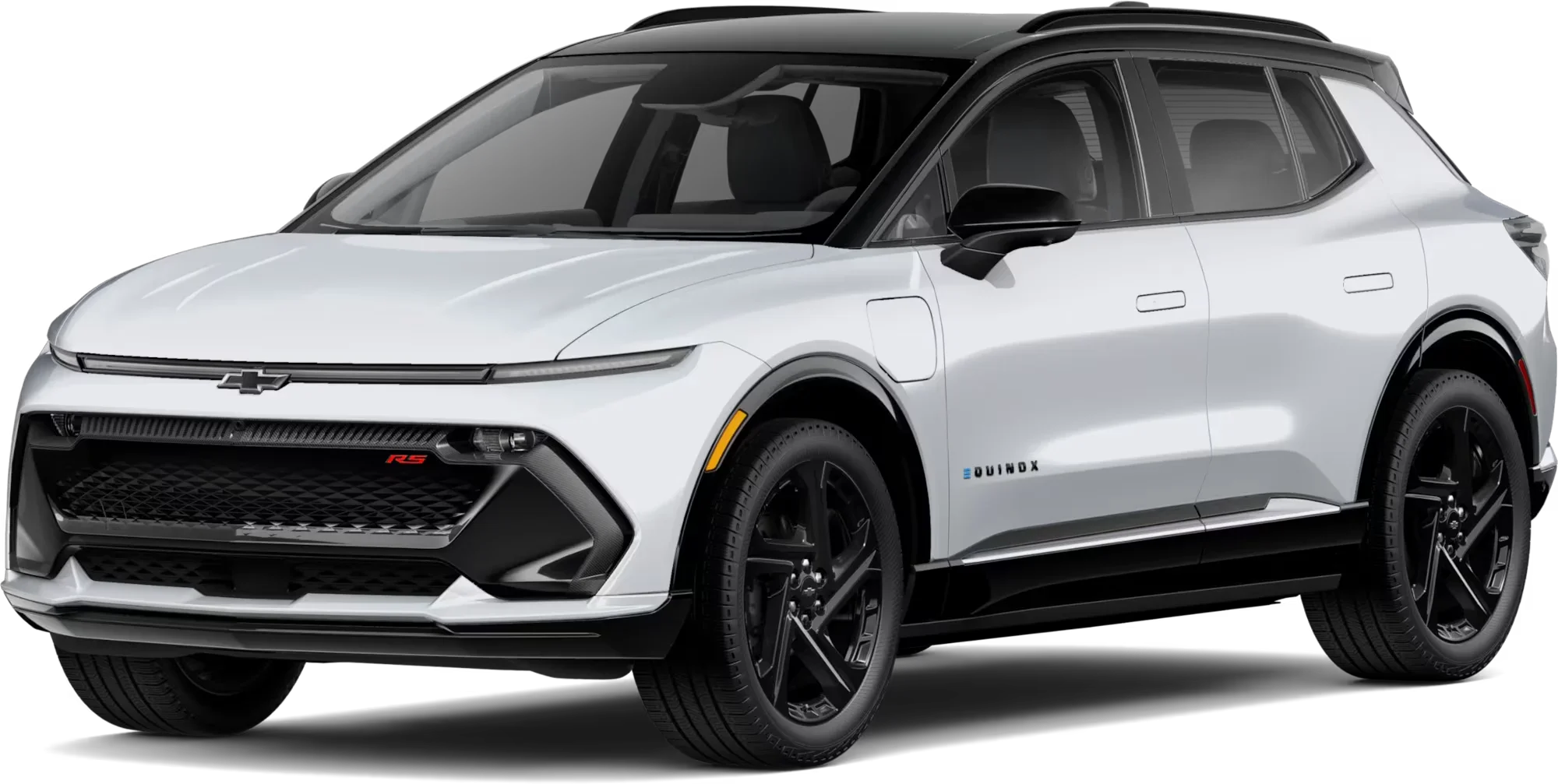





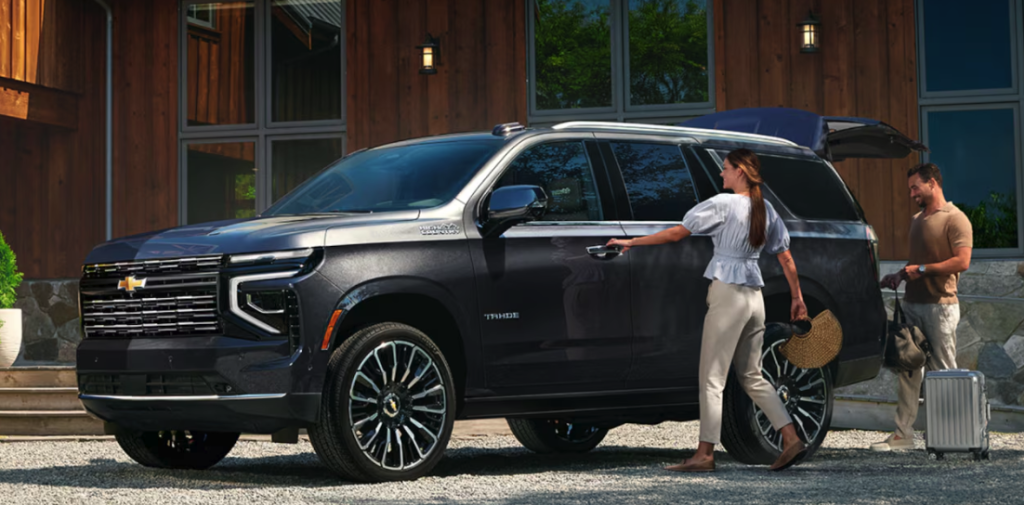
The Chevrolet Tahoe and Suburban can carry essentially the same number of people, offer the same three engine choices, and share much of the same technology. The main difference is space. The 2027 Tahoe is 211.3 inches long with up to 122.7 cubic feet of maximum cargo volume, while the 2027 Suburban stretches to 226.3 inches and provides up to 144.5 cubic feet.
For a Bartlett family, the deciding question is not simply whether you want the bigger SUV. It is how often you need all three rows of seats and a large cargo area at the same time. Tahoe leaves 25.5 cubic feet behind its third row, while Suburban provides 41.5 cubic feet, a substantial difference when passengers, suitcases, sports bags, strollers, coolers, or pet gear all need to travel together.
If that extra space would be used regularly, Suburban has a clear purpose. If your third row is used only occasionally or your normal family trips do not fill the cargo area, Tahoe delivers much of the same full-size Chevrolet SUV experience in a body that is 15 inches shorter.
Table of Contents
- Tahoe and Suburban Basics
- Seating and Cargo
- Engine Options
- Safety and Technology
- Which Full-Size Chevy SUV Fits Your Family?
- Tahoe vs Suburban Comparison Table
- Towing, Parking, and Family Travel
- The Space Question That Matters Most
- Memphis-Area Family SUV Needs
- What to Check on a Tahoe vs Suburban Test Drive
- Ownership Reality Check
- Key Takeaways
- Tahoe vs Suburban FAQ
Tahoe and Suburban Basics
Tahoe and Suburban occupy the full-size end of Chevrolet's SUV lineup. Both offer three rows, body-on-frame construction, rear-wheel-drive and four-wheel-drive configurations depending on model and equipment, three available engine choices, and many of the same comfort and driver-assistance technologies.
That shared foundation is why a Tahoe-versus-Suburban decision should not start with features that both can provide. A family can equip either SUV with similar power, similar seating layouts, large Chevrolet touchscreen technology, and many of the same trim choices.
The more useful distinction begins with physical dimensions. Chevrolet lists the 2027 Tahoe at 211.3 inches long. The 2027 Suburban is 226.3 inches long, giving the Suburban an additional 15 inches of overall length.
That added length goes primarily toward interior packaging and cargo capacity. It does not turn Suburban into a higher-passenger-count version of Tahoe. Both can be configured for up to nine occupants in appropriate LS seating configurations.
Seating and Cargo
Both SUVs have eight standard seats in their base configurations, with seven- and nine-seat layouts available depending on model and seating selection. This is one of the most important facts in the comparison because it changes the way the Suburban should be viewed.
Suburban's main family advantage is not an additional row or a higher maximum passenger count. Its advantage is how much more cargo space remains when you are already using those passenger seats.
The Tahoe provides 25.5 cubic feet of cargo space behind the third row, 72.5 cubic feet behind the second row, and up to 122.7 cubic feet with the rear seating areas folded. Suburban increases those figures to 41.5 cubic feet behind the third row, 93.8 cubic feet behind the second row, and 144.5 cubic feet maximum.
The difference behind the third row is particularly useful. Suburban gives you about 16 cubic feet more cargo room while preserving all three rows for passengers. That is a much more relevant family metric than maximum cargo volume if your third row normally stays occupied.
Engine Options
Tahoe and Suburban offer the same three core engine choices for 2027, so engine selection does not usually determine which body size you need.
- 5.3L EcoTec3 V8: 355 horsepower and 383 lb-ft of torque.
- 6.2L EcoTec3 V8: 420 horsepower and 460 lb-ft of torque.
- 3.0L Duramax Turbo-Diesel: 305 horsepower and 495 lb-ft of torque.
The 5.3L V8 is standard on most models other than High Country. The 6.2L V8 is standard on High Country and available on specified upper trims, while the Duramax diesel is available across several LT-and-above configurations.
That shared engine menu makes the comparison cleaner. If you like the torque characteristics of the Duramax or the output of the 6.2L V8, you do not need to choose Suburban simply to get that powertrain. The more meaningful decision is still how much vehicle length and cargo capacity you need.
Safety and Technology
Both SUVs use Chevrolet's large 17.7-inch center touchscreen and current connected-technology ecosystem. Depending on trim and equipment, features can include Google built-in, wireless smartphone connectivity, available camera views, Head-Up Display technology, and other convenience systems.
Available Super Cruise is offered on specified Tahoe and Suburban models. Chevrolet also offers Super Cruise functionality that can account for trailering on compatible roads and properly equipped vehicles.
Super Cruise remains an advanced driver-assistance technology, not autonomous driving. The driver must remain attentive and ready to take control, and availability depends on the exact model, equipment, compatible roads, and connected-service requirements.
Both Tahoe and Suburban also provide suites of standard safety and driver-assistance features. Because their technology is broadly similar, safety-feature lists should not be the main reason to choose the longer body.
Which Full-Size Chevy SUV Fits Your Family?
The fastest way to narrow the choice is to imagine the vehicle on your busiest realistic family day rather than your easiest one.
If five people use the SUV most of the time and the third row mainly handles occasional friends or relatives, Tahoe's 25.5 cubic feet behind row three may be enough. Folding part or all of the rear seating expands the available cargo room significantly when you need it.
If six, seven, or eight occupants travel frequently and their luggage needs to remain behind them, Suburban starts solving a problem that Tahoe cannot solve simply by folding a seat. That is where the extra 15 inches of overall vehicle length becomes valuable rather than just making the SUV physically bigger.
2027 Tahoe vs Suburban Comparison Table
| Feature | 2027 Tahoe | 2027 Suburban |
|---|---|---|
| Overall Length | 211.3 in. | 226.3 in. |
| Length Difference | Baseline | 15 in. longer |
| Standard Seating | 8 | 8 |
| Available Seating | 7 or up to 9 depending on configuration | 7 or up to 9 depending on configuration |
| Cargo Behind 3rd Row | 25.5 cu. ft. | 41.5 cu. ft. |
| Cargo Behind 2nd Row | 72.5 cu. ft. | 93.8 cu. ft. |
| Maximum Cargo | 122.7 cu. ft. | 144.5 cu. ft. |
| 5.3L V8 | 355 hp / 383 lb-ft | 355 hp / 383 lb-ft |
| 6.2L V8 | 420 hp / 460 lb-ft | 420 hp / 460 lb-ft |
| 3.0L Duramax | 305 hp / 495 lb-ft | 305 hp / 495 lb-ft |
| Primary Family Advantage | Full-size capability in a shorter footprint | Much more cargo space with all rows in use |
The numbers show why simply describing Suburban as "the bigger Tahoe" misses the practical decision. Passenger capacity and engine options overlap heavily. The additional length primarily buys cargo volume, and its biggest benefit appears when the third row remains occupied.
Towing, Parking, and Family Travel
Both Tahoe and Suburban are available with substantial trailering capability, but towing is configuration-specific. Engine, drivetrain, axle ratio, equipment packages, payload, passengers, cargo, hitch load, and trailer setup all affect the actual rating of a particular vehicle.
Chevrolet currently lists Tahoe at up to 8,400 pounds of maximum available towing when properly equipped. For Suburban, Chevrolet's current 2027 product page contains inconsistent published maximum figures between its main trailering section and FAQ, so the exact vehicle and current Chevrolet trailering documentation should be checked rather than relying on a single generic maximum.
That is a useful reminder not to assume that the physically larger SUV automatically tows more. Cargo capacity and trailering capacity are different measurements, and additional passengers or luggage can consume available payload even before trailer tongue weight is added.
For a broader look at Chevrolet trailering considerations, see the Chevrolet Towing Capacity Guide for Bartlett Drivers.
The Space Question That Matters Most
The strongest Tahoe-versus-Suburban question is not "How many people do you have?" Both SUVs can handle large passenger counts. The better question is: How often do you need the third row and a large cargo area at the same time?
When the third row stays folded for most of the year, Tahoe already offers extensive cargo flexibility. If you normally travel with four or five people, it may be easy to create additional cargo room by folding one section of the rear seating.
That changes once every seat has a job. If grandparents, children, teammates, friends, or extended family regularly occupy the third row, folding seats is no longer an available solution. At that point, Suburban's 41.5 cubic feet behind row three becomes a real functional difference rather than just a larger specification.
When Tahoe Is Likely the Better Fit
- Your third row is useful but not occupied on every trip.
- Most normal drives involve four to six people.
- You want full-size SUV passenger space and capability without choosing Chevrolet's longest SUV body.
- Parking, garage length, neighborhood maneuvering, or daily errands matter frequently.
- You can fold part of the third row when luggage or sports gear expands.
When Suburban Is Likely the Better Fit
- Your third row is occupied regularly.
- You frequently travel with six to eight people plus their luggage.
- You carry sports bags, coolers, strollers, pet equipment, or vacation gear while all seating rows remain in use.
- Long-distance family travel creates more cargo pressure than local maneuverability does.
- You already know that 25.5 cubic feet behind the Tahoe's third row would regularly feel limiting.
Suburban is easiest to justify when the extra space solves a repeatable packaging problem. Tahoe is easier to justify when you want nearly the same passenger and powertrain experience without carrying 15 additional inches of vehicle everywhere you go.
Memphis-Area Family SUV Needs
Bartlett and Greater Memphis driving can make both sides of this decision noticeable. Highway 64 errands, parking lots, school pickup, and normal suburban streets reward an SUV that is easy to place and maneuver. Longer I-40 trips, vacations, towing weekends, and multi-family outings make passenger-plus-cargo space more important.
School Runs and Everyday Errands
For daily school drop-off, groceries, commuting, and local appointments, the Tahoe's shorter length can be the more relevant specification. Both vehicles are full-size SUVs, so neither is compact, but a 15-inch difference can matter when pulling into tighter parking spaces or working around the dimensions of a home garage.
A household with two or three children does not automatically need Suburban. If the third row is mainly there for carpools or occasional guests, Tahoe can offer significant flexibility without making maximum cargo space a permanent requirement.
Sports, Activities, and Carpools
Sports schedules can change the equation quickly because equipment uses space even when the passenger count stays the same. A third row full of teammates plus bags, folding chairs, coolers, or other equipment creates a different packaging problem from simply transporting seven people.
This is where comparing cargo behind the third row matters more than comparing seating capacity. Both SUVs can carry the people. Suburban gives their equipment more dedicated space without asking someone to give up a seat.
Road Trips
On longer trips, every passenger tends to bring something. Suitcases, backpacks, snacks, coolers, pillows, pet gear, and other items quickly fill the area behind the third row. A family that feels comfortable in Tahoe during local driving may discover that the cargo area becomes the limiting factor during vacation travel.
Suburban's advantage is strongest in exactly that situation. The vehicle does not need to become a two-row SUV just to create useful luggage capacity.
If you are comparing Chevrolet SUVs beyond these two full-size models, the Chevrolet family SUV guide also covers Equinox, Traverse, Tahoe, and Suburban for different household sizes.
Boats, Campers, and Family Gear
Households that tow should evaluate two separate space questions: what the trailer weighs when loaded and what must still fit inside the SUV. Passenger weight, cargo, accessories, and tongue weight all affect vehicle capacity.
A Suburban may make the cabin easier to pack for a towing trip, but extra cargo room does not replace configuration-specific trailering limits. A Tahoe may have enough cabin capacity for a smaller family while offering the same basic engine choices.
What to Check on a Tahoe vs Suburban Test Drive
A useful Tahoe-versus-Suburban comparison should include more than driving each SUV around the block. Because so much of the difference is packaging, spend part of the comparison parked.
Park Both SUVs
Try a normal parking space rather than judging dimensions from the showroom. Pay attention to how much room remains at the front and rear, how easy it is to judge the corners, and whether the additional Suburban length changes your comfort level.
Use the Third Row
Have the people who will actually use the third row get in and out. Do not evaluate it only from the driver's seat. If children, teenagers, or adults will regularly sit there, check access with the second-row configuration you intend to buy.
Look Behind the Third Row
This may be the single most useful step. Keep all seats upright and inspect the cargo area as though the vehicle were packed for the trip that causes the most stress in your current SUV.
If possible, think in actual objects: stroller, sports bags, suitcases, cooler, pet crate, musical instruments, or whatever your household really carries. Maximum cargo volume with every seat folded does not answer that question.
Check Your Garage and Driveway
Vehicle length on a specification sheet becomes much more meaningful when compared with your parking environment. Suburban is 15 inches longer than Tahoe, so check whether that changes garage-door clearance, storage access, walking room, or driveway placement.
Compare the Same Type of Trim
Try not to compare a heavily equipped Suburban against a basic Tahoe and conclude the difference comes from vehicle size. Similar trims make it easier to isolate the actual body-size decision from leather, suspension, wheel, technology, or appearance differences.
Ownership Reality Check: Are You Buying Space You Will Use?
Suburban's extra room is valuable because it exists without asking passengers to surrender seats. That makes it a strong tool for families whose busiest trips regularly combine people and gear. But unused space still travels with you every day.
If your normal routine involves four people, moderate luggage, occasional third-row use, and frequent local driving, Tahoe may provide a better match between full-size capability and everyday footprint. You still have three rows, up to 122.7 cubic feet of maximum cargo room, the same broad engine menu, and many of the same technology choices.
If your family already knows what happens when every row is occupied and everyone brings luggage, Suburban's 41.5 cubic feet behind the third row addresses the problem directly. It is not simply a luxury of having more room. In that use case, it can keep the third row functional instead of turning every trip into a decision about which seat must be folded.
Do Not Choose by Passenger Count Alone
A family of five could need Suburban if every trip includes large sports equipment, pets, or frequent extended-family travel. A family of seven could still be comfortable in Tahoe if the third row is used mostly for short local drives without large amounts of cargo.
The better measure is the combination of passengers and cargo during the trips you take repeatedly.
Do Not Assume Bigger Means Better for Towing
Tahoe and Suburban towing capability depends on configuration. Bigger cargo capacity does not automatically mean a higher trailer rating. If towing is central to the purchase, confirm the exact vehicle rather than using SUV size as a shortcut.
Do Not Ignore the 15-Inch Difference
Fifteen inches may sound modest until the SUV is in a garage or parking space. It may also feel completely worthwhile when six passengers and their bags fit without compromise. That is why an in-person comparison is more useful than deciding from maximum-cargo numbers alone.
Key Takeaways
- The 2027 Tahoe and Suburban offer similar seating choices and the same three core engine options.
- Tahoe is 211.3 inches long, while Suburban is 226.3 inches long, a 15-inch difference.
- Tahoe provides 25.5 cu. ft. behind the third row; Suburban provides 41.5 cu. ft.
- Suburban's strongest advantage appears when all three rows remain occupied and the family still needs substantial luggage or gear space.
- Tahoe gives families full-size Chevrolet SUV capability in a shorter overall footprint.
- Trailering capacity is configuration-specific and should be verified for the exact vehicle rather than inferred from vehicle size.
Tahoe vs Suburban FAQ
How much bigger is a 2027 Suburban than a Tahoe?
Chevrolet lists the 2027 Tahoe at 211.3 inches long and the 2027 Suburban at 226.3 inches long. That makes Suburban 15 inches longer overall. The additional length contributes to its larger cargo area, particularly behind the third row.
Does a Suburban seat more people than a Tahoe?
Not necessarily. Both 2027 SUVs have eight standard seats and can be configured with seven seats or up to nine depending on the selected seating configuration. Suburban's primary advantage is additional cargo space rather than an extra passenger row.
Which has more cargo space behind the third row?
The 2027 Tahoe provides 25.5 cubic feet behind the third row, while the 2027 Suburban provides 41.5 cubic feet. That roughly 16-cubic-foot difference is especially useful for families that regularly keep the third row occupied while carrying luggage, sports equipment, strollers, coolers, or other gear.
Can a Tahoe tow more than a Suburban?
Towing depends on the exact engine, drivetrain, trailering equipment, axle configuration, payload, passengers, cargo, and other vehicle details. Chevrolet lists Tahoe at up to 8,400 pounds when properly equipped. Chevrolet's current 2027 Suburban page contains conflicting published maximum figures, so confirm the specific Suburban's current Chevrolet trailering documentation and vehicle labels before making a towing decision.
Compare Tahoe and Suburban in Bartlett
Tahoe and Suburban make the most sense for different versions of the same full-size SUV need. Tahoe gives you three-row flexibility, large cargo capacity, substantial available towing, and the same core powertrain choices in a shorter package. Suburban adds length where families often feel the pressure most: the cargo area behind occupied seats.
When you compare them, bring the real requirements with you. Think about who uses the third row, what normally travels behind it, where the vehicle will park, and whether towing is part of the plan. Current inventory and model availability can change, so review live Dobbs Brothers Chevrolet inventory before planning a specific test drive.