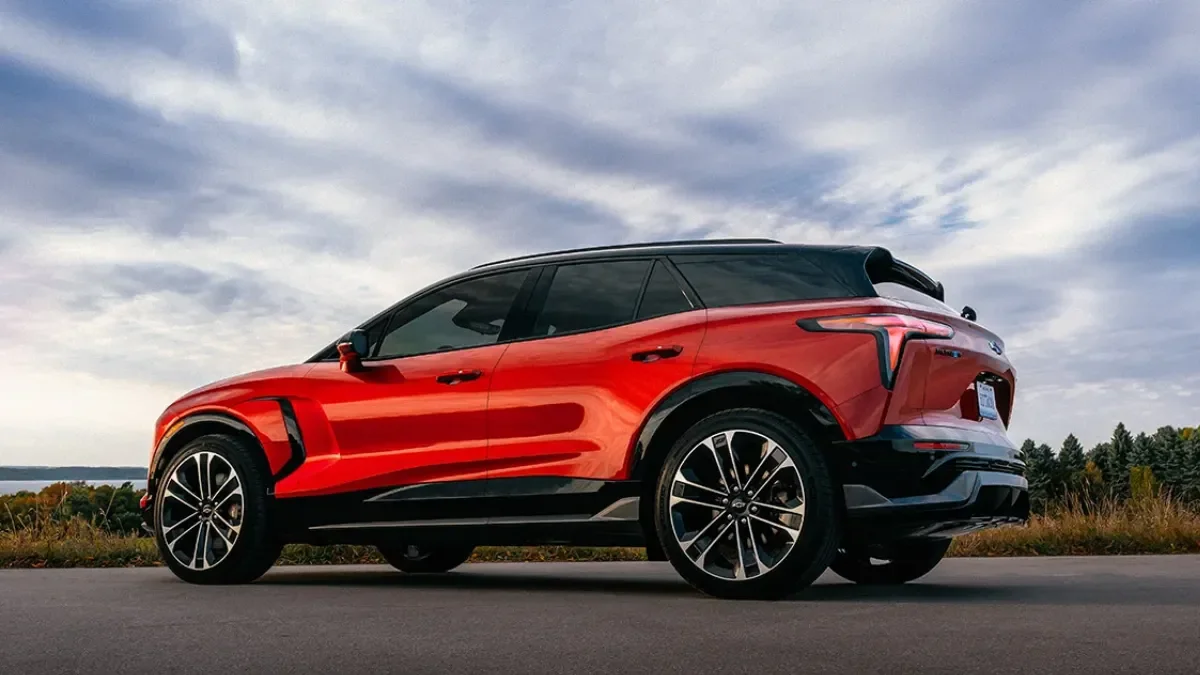





The 2027 Chevrolet Blazer EV SS is the performance flagship of the Blazer EV lineup, producing up to 615 horsepower and 650 lb-ft of torque with Wide Open Watts enabled. Chevrolet estimates 0–60 mph in 3.4 seconds with that performance mode active, while the SS still carries an EPA-estimated 302 miles of electric range, all-wheel drive, five-passenger seating and 59.1 cubic feet of maximum cargo space. That combination makes the SS more interesting than a simple acceleration story. For a Bartlett driver, the more useful question is whether the entire performance package fits your daily routine. The SS adds 22-inch wheels and standard Super Cruise with a three-year OnStar Super Cruise plan, while the 2027 Blazer EV also introduces a native NACS charge port that expands how easily owners can access compatible public charging infrastructure. If maximum acceleration is one of the reasons you want an EV, the SS has a very clear purpose. If your priorities are mostly commuting, range, charging convenience and Blazer EV styling, the RS deserves a close look too. The strongest Blazer EV choice is not automatically the one with the largest horsepower figure. It is the one whose performance, charging and technology package matches the miles you actually drive. What is the Blazer EV SS? The Chevrolet Blazer EV SS is the high-performance version of the all-electric Blazer EV SUV. For 2027, Chevrolet rates it at up to 615 horsepower and 650 lb-ft of torque with Wide Open Watts, with a GM-estimated 0–60 mph time of 3.4 seconds, 302 miles of EPA-estimated range, standard Super Cruise and 22-inch wheels. 2027 Chevrolet Blazer EV SS Performance & Ownership Guide Blazer EV SS Performance Basics 615 Horsepower and Wide Open Watts 0–60 Performance Blazer EV SS vs RS Range and Performance Tradeoffs 2027 NACS Charging Home Charging Bartlett and Memphis EV Ownership SUV Cargo and Daily Practicality Super Cruise and Technology Is the SS Too Much for Daily Driving? What to Compare on a Test Drive Ownership Reality Check Key Takeaways Blazer EV SS FAQ Blazer EV SS Performance Basics The SS sits above LT and RS in the 2027 Blazer EV lineup. Chevrolet positions LT as the more straightforward all-electric choice, RS as the style-focused step up and SS as the performance model. That structure matters because the SS is not simply an appearance package added to an RS. Chevrolet gives the SS a performance-oriented all-wheel-drive setup, Wide Open Watts performance mode, 22-inch Gloss Black wheels and substantially higher peak output. Super Cruise also becomes standard on SS rather than available equipment. At the same time, the SS keeps the practical structure that makes Blazer EV useful as an SUV. It seats up to five and retains 59.1 cubic feet of maximum cargo volume. You are not trading away the rear seats or cargo area to get the performance model. 615 Horsepower and Wide Open Watts The headline figures for the Blazer EV SS are 615 horsepower and 650 lb-ft of torque. Chevrolet specifies that those maximum numbers are achieved with Wide Open Watts, commonly referred to as WOW mode. That qualifier is important. Performance EV specifications often describe the vehicle at its maximum available output rather than implying every accelerator input in every drive mode produces the same response. Wide Open Watts exists specifically to unlock the SS's strongest acceleration capability. For normal Bartlett or Memphis driving, you do not need to use maximum performance simply because it is available. An EV can deliver immediate low-speed response during ordinary commuting without every trip becoming a full-power acceleration run. The advantage of the SS is that the additional output is available when you want it. This is also why the SS-versus-RS question should not begin and end with horsepower. If you have no interest in using that performance, a large portion of what makes SS distinct may not be central to your ownership experience. 0–60 Performance Chevrolet gives the 2027 Blazer EV SS a GM-estimated 0–60 mph time of 3.4 seconds with Wide Open Watts enabled. That is manufacturer-estimated performance under the conditions required for the system, not a promise that every launch on every surface will reproduce exactly 3.4 seconds. Temperature, battery state, road surface, tire condition and other variables can affect acceleration. More importantly, that level of acceleration needs to be treated with respect on public roads. The usefulness of the performance figure is that it shows how far SS sits above the normal expectation for a two-row Chevrolet SUV. Quick acceleration can be enjoyable for merging and passing, but maximum acceleration is rarely required for normal traffic. A test drive should therefore include ordinary throttle response as well as a safe demonstration of stronger acceleration where conditions allow. Performance AWD All-wheel drive is part of the SS performance formula. Electric AWD can react differently from a traditional gasoline drivetrain because propulsion can be managed electronically across the electric drive system without waiting for a conventional engine and transmission to build speed. That does not mean AWD eliminates traction limits. Tires still determine the physical contact with the road, and heavy rain, standing water or poor surfaces still require appropriate speed and attention. The useful distinction is that SS combines its high output with an AWD system rather than asking the front tires alone to manage 615 horsepower. The system helps turn the performance specification into usable propulsion, while normal driver responsibility remains unchanged. Blazer EV SS vs RS: What Actually Changes? RS is the most useful comparison for an SS shopper because both sit above LT and emphasize stronger visual identity. But the reason to move from RS to SS should be more specific than simply wanting the highest trim. The 2027 RS uses 21-inch wheels and offers Super Cruise as available equipment. Its headline 312-mile EPA range applies to the front-wheel-drive configuration. The SS uses 22-inch wheels, comes with Super Cruise standard and has its own 302-mile EPA-estimated range figure with its performance AWD setup. That means the range comparison is not perfectly apples to apples. The RS headline number represents FWD, while SS is the performance AWD model. Still, the figures tell you something important: Chevrolet has kept the SS above the 300-mile EPA threshold even while giving it dramatically more performance. 2027 Blazer EV RS vs SS Comparison Feature Blazer EV RS Blazer EV SS Primary Role Style-focused upper trim Performance flagship Headline Range 312 miles EPA-est. with FWD 302 miles EPA-est. Wheels 21-inch 22-inch Gloss Black Wide Open Watts No SS performance mode Yes Peak Output Depends on drivetrain configuration 615 hp / 650 lb-ft with WOW 0–60 mph Not positioned around SS launch performance 3.4 sec., GM-est. with WOW Super Cruise Available Standard with 3-year OnStar Super Cruise plan NACS Charge Port Standard 2027 architecture Standard 2027 architecture Best Decision Question Do I want Blazer EV style and range without SS output? Will I actually value the performance and standard technology? The SS upgrade makes the most sense when the performance itself is part of why you want the vehicle. It is not simply a more expensive RS with another badge. The propulsion performance, WOW mode, 22-inch wheel package and standard Super Cruise create a different ownership proposition. RS remains important because not every Blazer EV buyer needs 615 horsepower to enjoy electric response, large-screen technology and more than 300 miles of EPA-estimated range. Range and Performance Tradeoffs Chevrolet gives the 2027 Blazer EV SS an EPA-estimated electric range of 302 miles. That figure is useful for comparing vehicles under standardized testing, but it should not be treated as a guaranteed distance on every full charge. Real-world EV range changes with conditions. Higher highway speed, aggressive acceleration, cabin heating or cooling, extreme temperatures, elevation changes, passenger and cargo load and other factors can increase energy consumption. For an SS owner, driving style deserves particular attention because the vehicle makes strong acceleration so accessible. Using maximum output repeatedly consumes energy differently from maintaining a steady highway or suburban pace. 302 Miles Does Not Mean 302 Miles Every Time EPA range is a standardized estimate, not a promise. A driver making short Bartlett errands at moderate speeds may see a very different energy-use pattern from someone spending most of the day at sustained interstate speeds. That should not be interpreted as a flaw specific to Blazer EV. Gasoline vehicles also change fuel consumption based on speed, load, temperature and acceleration. EVs simply make the connection between energy use and remaining range more visible on the dashboard. Plan longer trips using the vehicle's current state of charge, route, charging availability and actual conditions rather than assuming the EPA number is a fixed travel radius. What WOW Mode Means for Everyday Range Wide Open Watts exists to access the SS's maximum performance. There is no reason to treat it as the default way the SUV must be driven. For the ordinary commute, smooth acceleration and regenerative braking can help make better use of stored energy. When you want the full performance experience, WOW is available. That separation is one of the useful characteristics of a performance EV: the vehicle can be extremely quick without requiring aggressive driving all the time. The ownership question is whether having that capability available matters enough to choose SS over a less performance-focused Blazer EV configuration. 2027 NACS Charging Changes the Blazer EV Ownership Equation One of the most meaningful updates for the 2027 Blazer EV is not horsepower. It is the charging port. Chevrolet now equips the 2027 Blazer EV with a standard NACS charge port. That is different from the previous model-year charging setup, where Tesla Supercharger access was described around compatible vehicles using a GM-approved NACS adapter. For a 2027 owner, the native NACS port simplifies access to compatible NACS charging infrastructure. Chevrolet says the Blazer EV can access more than 250,000 public chargers across North America and specifically highlights Tesla Supercharger access. Native NACS Port NACS refers to the charging connector standard used by Tesla and increasingly adopted across the North American EV industry. Having the port directly on the 2027 Blazer EV changes the physical connection compared with relying on an adapter for a compatible NACS charger. That does not mean every charging station automatically works in exactly the same way. Network access, charger compatibility, payment setup, vehicle software and charger availability still matter. Chevrolet also supports Plug & Charge at compatible public stations when the owner is enrolled in Energy Pass through the myChevrolet app. That can reduce the number of authentication steps at supported chargers. Why We Are Not Publishing a Peak 2027 DC Charging Rate Charging specifications are an area where older information can stay in search results long after a vehicle changes model years. Previous Blazer EV documentation and independent tests provide peak-rate and charging-time figures, but Chevrolet's current 2027 consumer page does not publish an exact peak DC rate in the primary specification set used for this article. For that reason, we would rather not carry a prior-year peak charging number into a 2027 buying guide and present it as current fact. Peak kW also does not tell the whole charging story. Battery temperature, starting state of charge, charger capability and charging curve all affect the speed of an actual session. A vehicle may touch a high peak briefly and still take a different amount of time overall than another EV with a similar headline number. Charging note: Public charging performance depends on the vehicle, battery temperature, state of charge, charger capability and network conditions. A charger displaying a high maximum output does not guarantee the vehicle will receive that rate throughout the session. Home Charging: The Most Important EV Question May Be Where You Park Chevrolet includes a Dual Level Charge Cord with the 2027 Blazer EV. The cord supports both Level 1 charging from a 120-volt source and Level 2 charging from an appropriate 240-volt source. For many EV shoppers, home charging matters more to day-to-day ownership than public fast charging. A vehicle that spends the night near a suitable home charging setup can begin many mornings with energy added while the owner was sleeping. Level 1 Charging Level 1 uses a standard 120-volt electrical source. It can be useful for lower-mileage routines, supplemental charging or situations where faster home charging is not immediately available. Because the charging power is much lower than a dedicated Level 2 setup, it may not be the most practical primary solution for a driver who regularly uses a large portion of the SS battery between charging sessions. Level 2 Charging Level 2 uses 240-volt charging and is generally the more useful home solution for drivers who expect to recharge an EV substantially overnight. The exact installation should be matched to the home's electrical system, charger and applicable local requirements. Do not assume an existing 240-volt outlet or circuit is automatically suitable simply because the connector can physically be adapted. A qualified electrician can evaluate circuit capacity and installation requirements when necessary. Home Charging vs Public Charging A Bartlett homeowner with convenient 240-volt access has a very different EV routine from a driver who relies primarily on public stations. Neither situation automatically rules EV ownership in or out, but the amount of planning changes. If home charging is not available, look closely at the compatible public stations near your normal route, workplace and longer-trip destinations before deciding. The 2027 NACS port broadens charging compatibility, but location and reliability still matter more than a network count on a webpage. For a deeper introduction to Level 1, Level 2 and public DC charging concepts, Dobbs Brothers Chevrolet also has a Silverado EV Home Charging Guide for Bartlett. The vehicle is different, but the basic home-charging concepts remain useful. Bartlett and Memphis EV Ownership EV ownership around Bartlett does not require a special driving lifestyle, but it does reward planning around where the vehicle sits and where it travels most often. A local commuter who can charge at home may rely on public fast charging only occasionally. A driver making frequent regional trips has more reason to understand public charging locations and route-planning tools. Someone without home charging needs to evaluate charging infrastructure much earlier in the shopping process. Memphis Highway Driving Sustained highway speed can increase energy consumption compared with slower mixed driving. That means a driver spending significant time on I-40 or I-240 should think in terms of real route conditions rather than assuming the EPA figure will appear identically on every trip. The myChevrolet app can help locate available public chargers and plan routes, but charging stops should still be considered with enough buffer for traffic, charger availability and changing conditions. Tennessee Heat and Climate Control Hot weather does not justify exaggerated claims that heat automatically ruins an EV battery. Modern EVs use thermal-management systems designed to manage battery temperature. However, climate-control demand and environmental conditions can affect vehicle energy use. Cooling the cabin on a hot day consumes energy, just as heating or air conditioning affects fuel use in a combustion vehicle. Preconditioning while the vehicle is connected to home charging can sometimes help prepare the cabin before departure without relying entirely on stored battery energy after the trip begins. Charging Routine Matters More Than Charging Anxiety The most useful way to evaluate EV ownership is to compare the vehicle's available range and charging options with your actual weekly mileage. If the SS regularly travels much less than its available range and returns to a reliable charging location each night, charging may become a routine rather than a special event. If the vehicle is expected to cover long distances frequently without dependable home charging, public infrastructure becomes a larger part of the decision. That distinction is more valuable than simply asking whether 302 miles is “enough.” Performance Without Giving Up SUV Practicality The Blazer EV SS is unusually quick, but Chevrolet has not turned it into a two-seat performance experiment. It still seats up to five passengers and provides up to 59.1 cubic feet of maximum cargo space. That matters because the vehicle can serve more than one role. A driver can use the performance on an appropriate road and still use the same SUV for commuting, grocery runs, luggage, family travel or daily cargo. Five-Passenger Layout SS keeps the same basic two-row passenger mission as the rest of the Blazer EV lineup. A performance buyer is not being asked to sacrifice the second row to access the highest-output model. If you regularly need three rows, however, Blazer EV is not designed to solve that problem. The SS performance badge does not change the seating architecture. 59.1 Cubic Feet of Maximum Cargo Space Maximum cargo volume provides flexibility for larger loads when the rear seating is configured appropriately. The important ownership point is that the SS maintains this cargo architecture while adding its performance hardware. For shoppers cross-shopping performance sedans or coupes, that can be a major reason to consider the Blazer EV SS. The straight-line performance is paired with a conventional SUV hatch and rear-seat arrangement. 22-Inch Wheels Are Part of the Ownership Package The SS uses 22-inch Gloss Black wheels, compared with 21-inch wheels on RS. That visual difference supports the performance styling, but it also means tire size should be part of the ownership discussion. Check the exact tire specification on the vehicle and compare replacement options before purchase. Large-wheel performance setups can have different replacement availability and cost than smaller wheel packages. The smartest test drive is therefore not limited to acceleration. Drive the SS over the same ordinary pavement you use every day and decide whether its wheel-and-tire package fits your comfort expectations. Super Cruise and Blazer EV SS Technology Super Cruise is standard on the 2027 Blazer EV SS and includes a three-year OnStar Super Cruise plan. On LT and RS, Chevrolet lists Super Cruise as available rather than standard. That makes driver-assistance technology part of the SS value proposition, not merely another performance specification. What Super Cruise Does Super Cruise is Chevrolet's hands-free driver-assistance technology for compatible roads and properly equipped vehicles. It can manage aspects of steering and vehicle speed under supported conditions while monitoring driver attention. It is not autonomous driving. The driver remains responsible for the vehicle, must stay attentive and must be prepared to take control. Road compatibility, system conditions, vehicle equipment and active connected-service requirements all matter. The fact that your route is a highway does not automatically mean Super Cruise will operate everywhere on it. 17.7-Inch Center Display The Blazer EV uses a standard 17.7-inch center touchscreen with Google built-in compatibility. That gives navigation, vehicle controls and connected features a large central interface. The 2027 vehicle also supports Chevrolet's current connected ecosystem, including route planning and public-charger location through the myChevrolet app. OnStar Basics Chevrolet currently lists OnStar Basics as standard for eight years on the 2027 Blazer EV, covering a set of core connected features. That is separate from the SS's three-year Super Cruise plan and should not be treated as if every connected service remains included indefinitely. Subscription structures can change, so verify the exact active plans and included trial periods on the vehicle at the time of purchase. Is the Blazer EV SS Too Much for Daily Driving? 615 horsepower is far beyond what is required for a normal commute. That does not automatically make the SS a poor daily vehicle. It simply means the performance itself has to be something you value rather than something you feel obligated to use constantly. The SS makes the strongest case for buyers who want an SUV that can behave normally during everyday driving while delivering very strong acceleration when requested. The performance does not remove its cargo space, five-seat layout or charging functionality. The SS Makes More Sense If... You actively want the 615-hp Wide Open Watts performance capability. Strong acceleration is part of the reason you are choosing an EV. Standard Super Cruise adds meaningful value to your highway routine. 302 miles of EPA-estimated range fits your normal travel pattern. You prefer the SS 22-inch wheel design and performance-focused appearance. You have a charging plan that works for your daily mileage. RS May Make More Sense If... You like Blazer EV design but do not need maximum SS acceleration. The 312-mile FWD headline range is more relevant to your priorities. You want 21-inch wheels rather than the SS 22-inch setup. You prefer to treat Super Cruise as an available option rather than part of the standard trim package. Normal EV response and everyday practicality matter more than a 3.4-second 0–60 estimate. The SS does not need to “win” this comparison. It serves a more specialized buyer. If that specialization matches your priorities, it has a clear reason to exist. If it does not, RS still gives you Blazer EV technology, electric propulsion and substantial range without asking you to buy the highest-output version. Check Current Chevrolet EV Availability What to Compare on a Blazer EV SS Test Drive A performance EV test drive should tell you more than how hard the vehicle accelerates. The SS spends far more time traveling normally than launching from a stop, so test the entire ownership experience. 1. Start in Normal Driving Drive the vehicle through the kind of traffic and streets you actually encounter. Pay attention to low-speed throttle response, steering, visibility and brake feel before testing the stronger performance modes. 2. Compare Regenerative Braking Blazer EV includes regenerative-braking technology such as One Pedal Driving. If you are new to EVs, try the available settings and understand how lifting off the accelerator changes deceleration. Some drivers adapt quickly to stronger regeneration. Others prefer more conventional coasting behavior. This can affect everyday satisfaction more than the 0–60 figure. 3. Evaluate the 22-Inch Wheel Setup Drive over ordinary pavement seams, patched roads and the surfaces you encounter around Bartlett and Memphis. The point is not to search for the worst pothole available. It is to understand how the performance wheel-and-tire package feels during normal ownership. 4. Sit in the Rear Seat If the vehicle will carry family or coworkers, spend time outside the driver's seat. Check rear-seat access, legroom, visibility and how the cabin feels with normal passengers aboard. 5. Use the Cargo Area Open the hatch and look at the space in the context of what you actually carry. Maximum cargo numbers are useful, but suitcases, sports gear, work bags or pet equipment are easier to visualize in person. 6. Ask About Super Cruise Setup Confirm the exact Super Cruise plan included with the vehicle, how activation works and which connected-service requirements continue after the initial included period. 7. Map Your Charging Routine Before leaving the dealership, know where you expect to charge most often. Home Level 2 access, workplace charging and compatible public NACS stations create very different ownership patterns. If your entire charging strategy is “I'll figure it out later,” solve that question before making the performance decision. Ownership Reality Check: The 0–60 Number Is the Easy Part A 3.4-second GM-estimated 0–60 time is simple to understand and easy to market. The harder question is whether you want the rest of the SS package during every mile when you are not launching from a stop. That package includes 22-inch wheels, a 302-mile EPA-estimated range, performance AWD, standard Super Cruise and the practical realities of charging an EV. Those details will influence ownership far more often than the maximum acceleration figure. If you can charge conveniently, like the SS road feel, value Super Cruise and genuinely enjoy having the performance available, the SS combines unusual speed with normal SUV usability. If home or public charging would be inconvenient, or if 615 horsepower is interesting mainly as a number on the specification sheet, solve those issues before deciding the SS badge is necessary. Performance Does Not Replace a Charging Plan A fast EV still needs to charge. The native NACS port makes public charging compatibility easier for 2027, but convenient home charging can still have a larger effect on ownership satisfaction than access to maximum acceleration. Range Depends on How You Drive EPA-estimated range gives you a comparison baseline. Your actual energy consumption is shaped by speed, temperature, climate use and acceleration. A performance vehicle driven aggressively should not be expected to return exactly the same consumption pattern as one driven gently. Super Cruise Does Not Make the SS Self-Driving The technology can reduce some of the workload on compatible roads, but the driver remains responsible. That limitation does not disappear because Super Cruise comes standard on SS. The SS Still Has to Work as Your SUV The strongest reason to choose a performance SUV instead of a dedicated performance car is that it can handle ordinary life too. Five seats and 59.1 cubic feet of maximum cargo volume are part of the Blazer EV SS story, not footnotes to its horsepower. Key Takeaways The 2027 Blazer EV SS produces up to 615 horsepower and 650 lb-ft of torque with Wide Open Watts. Chevrolet estimates 0–60 mph in 3.4 seconds with WOW mode enabled. SS has an EPA-estimated 302 miles of electric range and retains seating for five plus 59.1 cu. ft. of maximum cargo space. 2027 introduces a native NACS charge port and Chevrolet says Blazer EV can access more than 250,000 public chargers across North America. Super Cruise is standard on SS with a three-year OnStar Super Cruise plan, while it remains available on RS. RS deserves consideration if maximum SS performance matters less than range, styling, charging and everyday EV practicality. Blazer EV SS FAQ How much horsepower does the 2027 Blazer EV SS have? Chevrolet rates the 2027 Blazer EV SS at up to 615 horsepower and 650 lb-ft of torque with Wide Open Watts enabled. Those are the SS model's peak performance figures with WOW mode, not separate engine specifications because the Blazer EV uses an electric propulsion system. How fast is the 2027 Blazer EV SS from 0–60 mph? Chevrolet gives the Blazer EV SS a GM-estimated 0–60 mph time of 3.4 seconds with Wide Open Watts enabled. Real acceleration can vary with road surface, battery condition, temperature, tires and other conditions. What is the range of the 2027 Blazer EV SS? The 2027 Blazer EV SS has an EPA-estimated electric range of 302 miles. EPA estimates are useful for standardized comparisons but do not guarantee a specific real-world distance because speed, temperature, climate use, driving style, terrain and load can affect energy consumption. Does the 2027 Blazer EV SS need an adapter for Tesla Superchargers? The 2027 Blazer EV introduces a native NACS charge port, and Chevrolet specifically highlights access to compatible Tesla Superchargers. That differs from prior Blazer EV model-year information that discussed Supercharger access through a GM-approved NACS adapter. Charger compatibility and network requirements should still be checked for the specific station you plan to use. Compare Blazer EV Options in Bartlett The 2027 Blazer EV SS combines genuine performance-car acceleration with the passenger and cargo layout of a two-row electric SUV. Its 615-horsepower Wide Open Watts output, 302-mile EPA estimate, standard Super Cruise and native NACS port make it much more than a simple appearance trim. That does not automatically make SS the right Blazer EV for every shopper. If you want the performance, can support the charging routine and value the SS-specific technology and wheel package, it has a clear role. If your priorities lean more toward range, styling and everyday EV use, compare the RS before deciding. Current Blazer EV availability can change, so check live Dobbs Brothers Chevrolet inventory for current trims and configurations rather than assuming a specific SS is on the lot. Check Current Chevrolet EV Availability Related Chevrolet Insights & Updates EV SUV Comparison 2026 Chevrolet Blazer EV vs Equinox EV: Which Electric SUV for Bartlett Compare Chevrolet's two electric SUVs by range, size, charging, everyday practicality and local EV ownership needs. Read More Equinox EV Guide 2026 Chevrolet Equinox EV: Range, Charging, and Pricing Near Bartlett TN Explore another Chevrolet EV option if range, value and everyday electric-SUV practicality matter more than SS-level performance. Read More EV Charging Guide Silverado EV Home Charging Guide for Bartlett Learn the differences between Level 1, Level 2 and public DC charging when planning a home-based Chevrolet EV routine. Read More Efficiency Guide Most Fuel Efficient 2026 Chevrolet Models for Bartlett TN Drivers Compare gas, diesel and electric Chevrolet options for commuting, efficiency and everyday ownership around Bartlett. Read More